

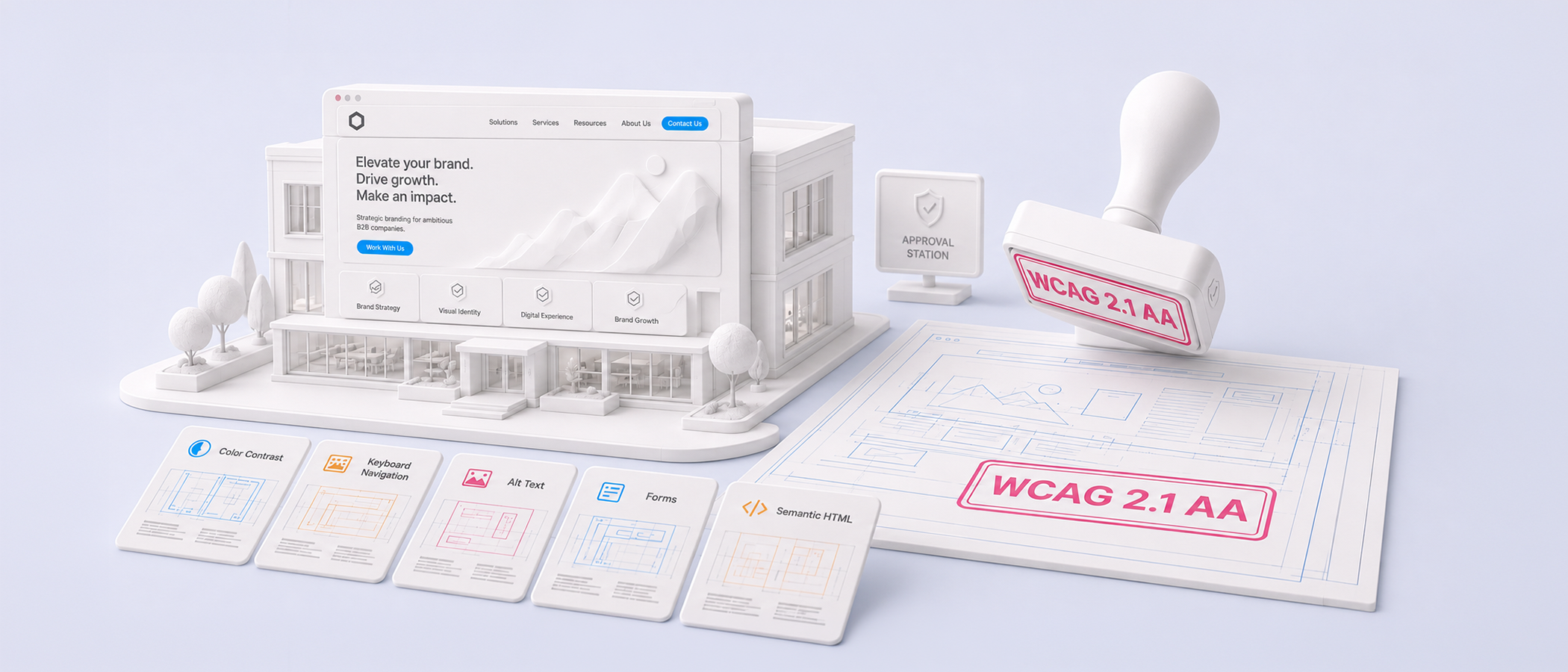
Most B2B companies hear "web accessibility" and think it's a concern for large consumer brands, government websites or healthcare portals. Something important, sure, but not urgent for a B2B company selling industrial equipment or professional services.
That assumption is increasingly expensive. Over 4,000 federal ADA website lawsuits were filed in the US in 2023 alone, and B2B companies are firmly in the crosshairs. The legal standard courts use to assess compliance is WCAG 2.1 AA, and most B2B websites fail it on multiple counts without their owners ever knowing.
This post explains what WCAG is, why it's now effectively a legal requirement for any business with US customers, what non-compliance actually looks like on a typical B2B website and what you need to do about it.
What is WCAG?
WCAG stands for Web Content Accessibility Guidelines. It's a set of technical standards published by the World Wide Web Consortium (W3C) that defines how websites should be built so they're accessible to people with disabilities, including visual impairments, hearing loss, motor difficulties and cognitive disabilities.
WCAG is organised into three conformance levels:
WCAG 2.1 AA is the level your website needs to meet. The current version is WCAG 2.2 (released October 2023), which adds a small number of new requirements to 2.1. For practical compliance purposes, targeting WCAG 2.1 AA is the established benchmark, courts and regulators in the US have consistently referenced this standard.
The US Legal Situation, Why This Is Urgent Now
The Americans with Disabilities Act (ADA) was signed in 1990, long before most businesses had websites. For years, there was genuine legal ambiguity about whether the ADA applied to websites at all. That ambiguity is now resolved.
Since the DOJ guidance, ADA website lawsuits have accelerated significantly. Serial plaintiffs, individuals and law firms who file large numbers of ADA cases, have expanded their targets beyond retail and hospitality to include professional services, manufacturing, software and B2B companies of all sizes.
The standard legal argument in these cases is straightforward: a person with a disability visited your website, encountered a barrier that prevented them
from accessing your goods or services, and your website's non-compliance with WCAG 2.1 AA caused that barrier. Courts have consistently found in favour of plaintiffs on this basis.
The Four Principles of WCAG, POUR
WCAG is built around four core principles, often abbreviated as POUR. Every guideline and success criterion maps back to one of these:
What Non-compliance Looks Like on a Typical B2B Website
Most B2B websites fail WCAG 2.1 AA on several counts, not out of negligence but simply because accessibility was never part of the brief when the website was built. Here are the most common failures:
Beyond Legal, The Business Case for WCAG Compliance
Legal risk is the urgent reason to address WCAG compliance. But there are genuine business benefits that make it worth doing properly, not just minimally.
The last row deserves particular attention for B2B companies. US federal agencies and many large enterprises include web accessibility requirements in their procurement criteria. A B2B company pursuing government contracts or enterprise accounts that cannot demonstrate WCAG compliance may be disqualified before the conversation even starts.
What to Do, A Practical Starting Point
Full WCAG 2.1 AA compliance requires a systematic audit and remediation process. But here's where to start:
Every website iGenius builds is developed to WCAG 2.1 AA standards, semantic HTML structure, proper ARIA attributes, contrast-checked color palettes, keyboard navigable components and accessible form design are built into our development process from the start, not added as an afterthought. See how our web design and development service approaches accessibility as a foundation, not a checklist.
Frequently Asked Questions

Stay in the loop
Get B2B branding insights in your inbox
One practical article every two weeks. No fluff, no spam.