
Your B2B website might rank on Google's first page. Your SEO might be in good shape. Your content might be well-written and regularly updated. And you might still be completely invisible to the buyers who are actively searching for exactly what you offer right now.
Because they're not searching on Google. They're asking ChatGPT. They're querying Perplexity. They're reading Google AI Overviews. And when they do, your name probably isn't coming up — even if you're one of the best options available.
800 million people use ChatGPT every week — but that's not the number that matters for your business. What matters is this: B2B buyers specifically — procurement managers, heads of operations, CTOs, VPs of business development — are using AI tools to research and shortlist vendors before they ever make contact. Your total addressable market might be 200 companies globally. But if the decision-makers inside those companies are using AI to build their shortlist, and your brand isn't appearing, the size of the overall AI user base is irrelevant. You're missing the specific people who matter.
This isn't a future problem. It's already happening, and for most B2B companies, it's already costing leads they don't even know they're losing.
The Silent Problem Most B2B Companies Don't Know They Have
Traditional search has a clear feedback loop. You check your Google rankings, your Search Console traffic, your click-through rates. If something drops, you can see it and respond.
AI search invisibility has no such feedback loop. You don't get notified when ChatGPT recommends your competitor instead of you. You don't see a traffic dip on the day a procurement manager at a target account asks Perplexity for vendor options in your space and your name never comes up. The leads you lose to AI search invisibility never appear in your analytics — because the buyer never visited your website at all.
B2B buying is already a high-research process. Buyers spend weeks or months evaluating options before engaging vendors. AI tools have simply become part of that research phase — used by the same procurement managers, technical evaluators and C-suite decision-makers who were previously spending that time on Google and LinkedIn. The audience is the same. The research channel has changed.
This is why so many B2B companies right now are experiencing a vague sense that something has changed — the pipeline feels slightly thinner, inbound feels slightly slower — without being able to point to a clear cause. AI search invisibility is often the cause they haven't thought to look for.
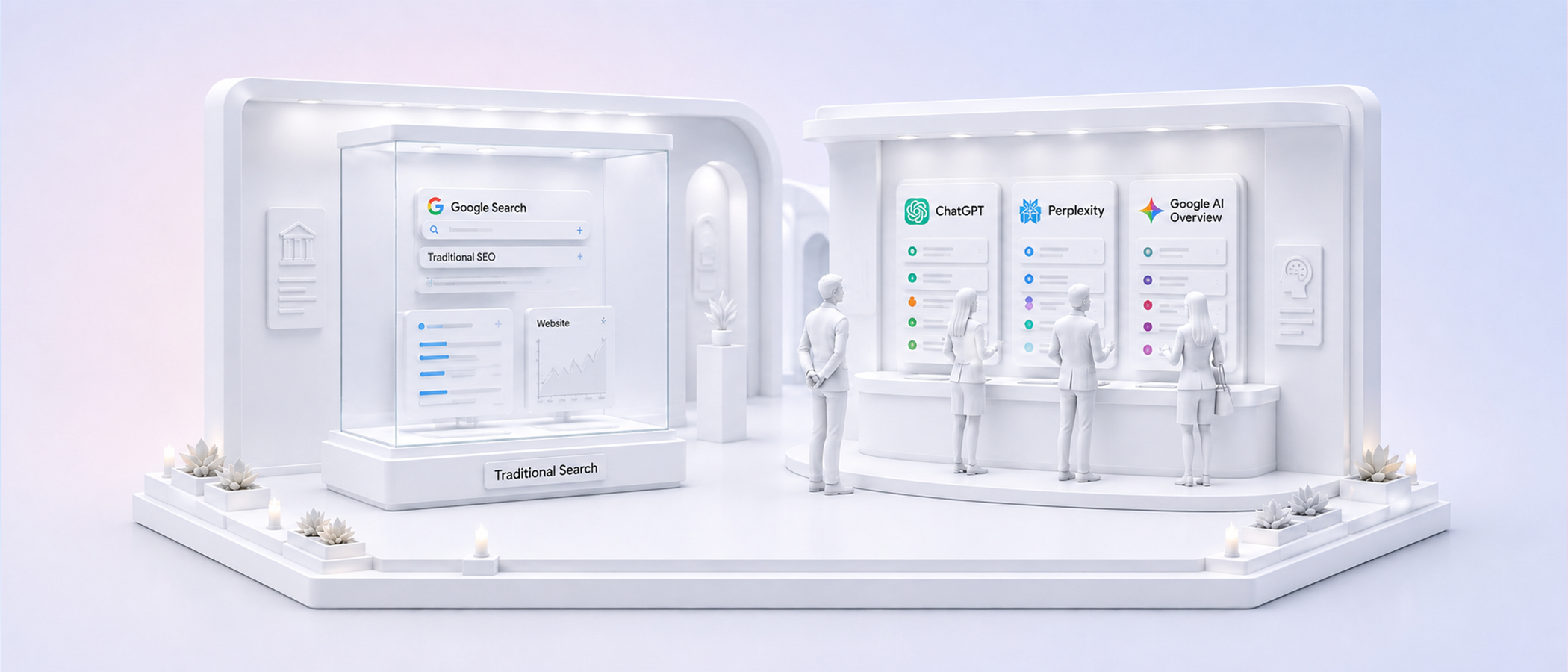
How Search Has Changed — and Why Your Website Wasn't Built for It
Most B2B websites were built and optimised for the left column. Good keyword placement, meta descriptions, structured navigation, quality backlinks — all of it designed to rank in a list of links. None of it was designed to be cited in an AI-generated answer.
That's not a criticism — it's simply that the rules changed. A website that was perfectly optimised for 2022 search can be structurally invisible to 2026 AI search despite ranking well on traditional Google.
Why Most B2B Websites Are Invisible to AI Search
The homepage alone tells the story for most B2B companies. It opens with "We are a leading provider of..." — a phrase that tells an AI engine nothing specific enough to cite. There are no direct answers to buyer questions anywhere on the page. There's no FAQ schema. There's no content depth. The website looks professional to a human but is structurally unsearchable to an AI.
The Silent Cost — What You're Actually Losing
The Traffic Reality — What's Actually Happening to B2B Organic Search
This Is Not an SEO Problem — It's a Different Problem
It's important to be clear about this, because it leads to the wrong solutions. AI search invisibility is not fixed by doing more SEO. It requires a distinct set of strategies — GEO (Generative Engine Optimisation) and AEO (Answer Engine Optimisation) — that work alongside SEO but address a fundamentally different question.
A business with strong SEO still needs GEO and AEO — they solve different problems for different parts of the same buyer journey. Most agencies only offer SEO. Almost none offer all three as an integrated strategy.
The Early Mover Window Is Closing
There is a genuine first-mover advantage in AI search right now — and it won't last long. Most B2B companies have no GEO or AEO strategy. The ones building it now are establishing topical authority, earning citations and getting named in AI answers before their competitors have even started thinking about it.
The question isn't whether AI search matters for your B2B brand. It does, right now, for your buyers. The question is whether you start building visibility before or after your competitors do. Read our step-by-step guide to getting cited in AI search results.
If you want to understand where your brand currently stands in AI search — and what specifically is making it invisible — a free Brand Audit from iGenius covers AI and search visibility as one of its core assessment areas.
Frequently Asked Questions

Stay in the loop
Get B2B branding insights in your inbox
One practical article every two weeks. No fluff, no spam.